
Threat Management Program Guide
What is Behavioral Threat Assessment and Management (BTAM)?
When someone makes a threat or shows concerning behavior, a structured approach to Threat Management can mean the difference between effective intervention and a missed opportunity for prevention.
BTAM is a systematic process that helps organizations:
- Identify warning signs and concerning behaviors before violence occurs
- Assess the credibility and severity of potential threats through evidence-based methods
- Manage risks through case-specific intervention strategies
- Monitor situations continuously to prevent escalation
Effective Threat Management requires a multidisciplinary team approach, bringing together perspectives from security, human resources, legal, and others. These teams, known as Threat Management Teams (TMT) collect and analyze information from various sources—including reported behaviors, communications, social media activity, and relevant background information—to determine appropriate responses.
Unlike reactive approaches, BTAM addresses underlying issues that contribute to concerning behavior, creating pathways to de-escalation while maintaining workplace safety and dignity for all involved. A key principle of BTAM is to "do no harm." Threat Management is a capability specifically designed to prevention targeted/intentional violence and is, therefore, an empathic process.
Organizations implementing structured Threat Management protocols fulfill their duty of care while creating environments where early intervention prevents potential harmful outcomes.
Setting up for Sucess
An effective Threat Management program fits within a Workplace Violence Prevention and Intervention (WVPI) program. Watch this video to learn about the key components of a WVPI program utilizing CPPS' "tiered approach."
Getting Started
This video shares insights on how to get started. Learn about what Behavioral Threat Assessment and Management is and how this capability makes all the difference!
Grab our Program Development Checklist!
This checklist outlines key components of a Threat Management program based upon prevailing standards and tasks associated with each to implement.
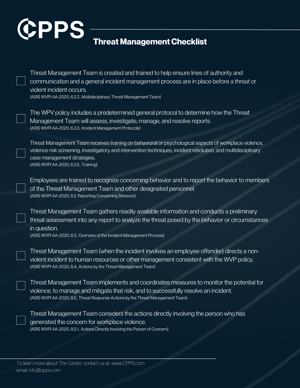
Building a Program
This section details each aspect of a Threat Management program and how to begin. Absent applicable legislation, the ASIS WVPI AA-2020 Workplace Violence and Active Assailant--Prevention, Intervention and Response Standard (the "ANSI Standard"), and OSHA Instruction 02-01-058 Enforcement Procedures and Scheduling for Occupational Exposure to Workplace Violence (the "OSHA Instruction") are key benchmarks to reference for building a program. These two documents (the "Standards") are known to be utilized in civil litigation and are longstanding precedent with respect to what a WVPI program requires, to include considerations for Threat Management.

Program Governance
Governance is key for Behavioral Threat Assessment and Management (BTAM) in that it standardizes the program and formulates how it'll operate for an organization. While terminology may be different, CPPS utilizes Governance because this document governs the Workplace Violence Prevention and Intervention (WVPI) program, implementing the organization's WVPI policy. The ANSI Standard outlines several core components to be addressed within the Governance, which it labels Incident Management Protocols and Protocols to Address Emergencies and Incidents that Generate Heightened Concern.
Multidisciplinary Team
Considering the dynamics of human behavior, Threat Management requires a team. In particular, one that is multidisciplinary in composition. The ASIS International Workplace Violence and Active Assailant--Prevention, Intervention and Response Standard (ANSI/ASIS WVPI AA-2020 Standard) outlines: "A WVPI program should include a multidisciplinary team created and periodically trained to evaluate and respond to violent incidents or reports of concerning behavior made."


Team Training
Given the critical nature of a TMT's work and to generate a competent team, TMTs require both initial and ongoing training as a team. The complexity of assessing and managing threats demands a high level of expertise, coordination, and preparedness. Training is also essential for understanding how each function on the team adds value when real incidents occur and aligns all members as equal on the team--every member has a voice on the TMT.
Expert Support
Effective WVPI requires a team approach and some aspects of BTAM require support from experts with demonstrable experience and knowledge. Both, the ANSI Standard and OSHA Instruction outline the importance of leveraging outside experts to supplement internal expertise, particularly in BTAM.

Threat Management Team Models
Organizing Your Team
Operational models for your Threat Management Team help organize your Violence Prevention program. Organizing your model helps align channels of communication and ensure cases are managed effectively. Check out the video, then grab the attached article to help organize your program!
Videos
Articles
The Critical Necessity for a BTAM Program
On April 17, 2025, gunfire shattered the calm outside Florida State University’s bustling Student Union. Two staff members were killed and six others wounded. Reporters later learned that the 20-year-old suspect, Phoenix Ikner, had been expelled from a campus debate club because of persistent racist tirades that made fellow students uneasy—an obvious warning sign in hindsight.
How to Develop a Threat Management Team
Building a successful Threat Management Team (TMT) involves establishing clear roles and operational protocols—but equally important is understanding the data behind effective threat management. According to the FBI's study, "Making Prevention a Reality" (2017), over 60% of violent workplace incidents displayed clear warning signs that, if properly reported and managed, could have prevented escalation.
The Importance of TMT Training
The concept of “Threat Assessment” and “Threat Management Teams” have increasingly become an essential part of comprehensive Workplace Violence Prevention and Intervention Programs globally. A brief definition of both concepts will help provide some context to our discussion.
Webinars
Podcast
Access the Safe Workplace Unlimited Package

Receive the critical support your TMT needs to operate effectively!
Your dedicated partner helping you solve the issue of violence
This package makes it easy to stay current, follow a consistent process, and receive expert support whenever needed. Highlights of the package:
- A formalized program for your entire organization
- Development, training, and real-time support for your TMT
- Aligning your program with prevailing compliance requirements
- Bonus: software-enabled support to truly make your program best-in-class